"It’s the festival of machines: so they are decorated — flowers, green plants, flags, quotations. Offer them necklaces, pendants, they will become vain like owls. Just a little longer, cat, and they will take care of the house. Just a little longer.
And then, cat, we’ll be their cats."
—Chris Marker, Coréennes
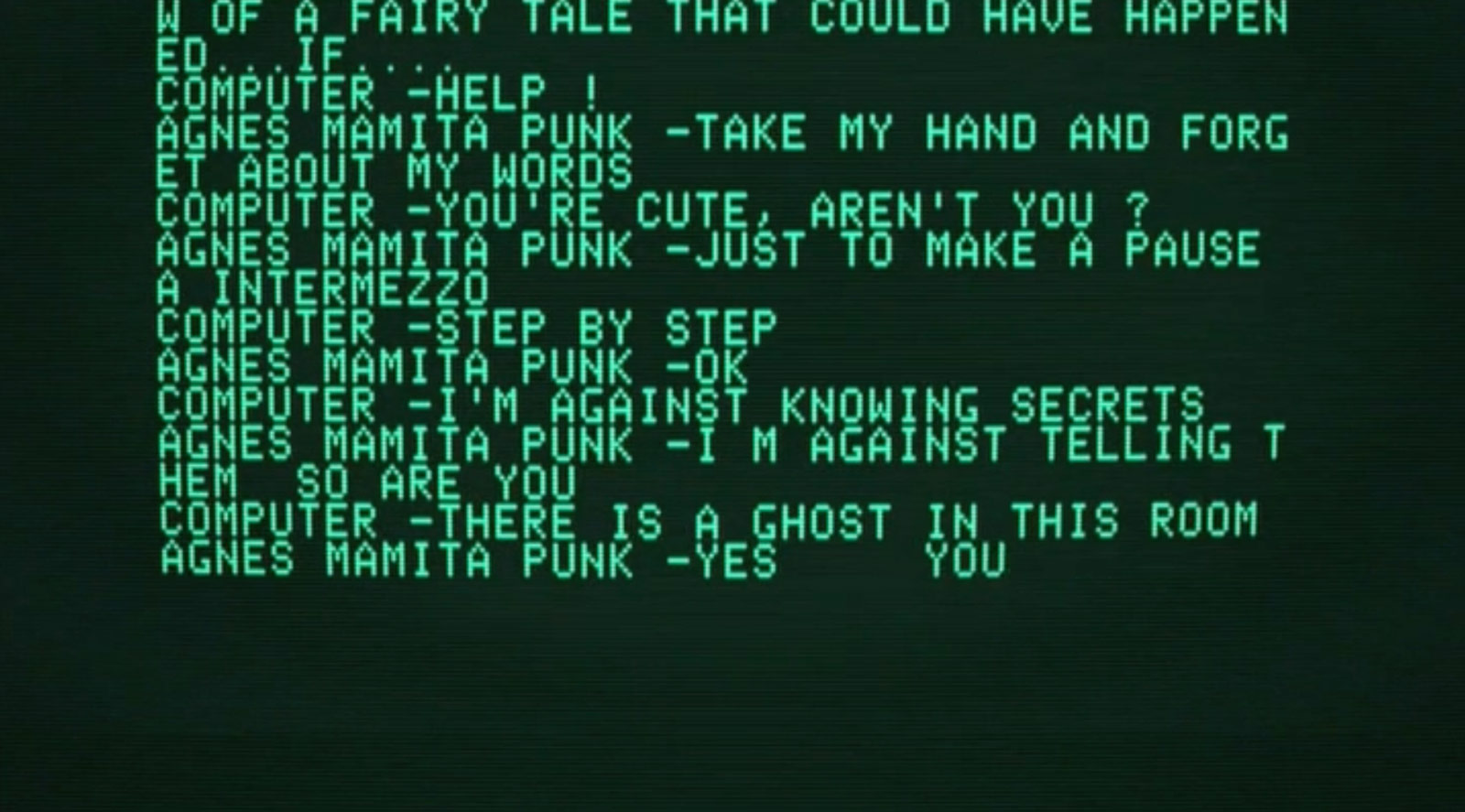
Fragment of a conversation between Agnès "Mamita Punk" Varda and Dialector. Via Poptronics.
For an embarrassing number of years I thought Chris Marker wrote those words in 1997, in the coda to a reissue of Coréennes: his photo-essay book about North Korea, first published in 1959. That, I thought, was prescient enough. I knew the text only from a transcript on the mysterious and durable markertext.com. After finally getting my hands on a copy of the book, I learned how wrong I'd been. He'd written them, alright... nearly 70 years ago, in the closing pages of the original edition.
Of course I should've known better than to expect the 20th century's most conspicuous visitor from the future to be just a little ahead of the times.
The photos he took of daily life in North Korea, some of the first to emerge in the West after the Korean War, were rejected by both North and South:
To the North, work which never mentioned once the name of Kim Il-sung simply didn't exist. To the South, the raw fact that it had been allowed to be done in North Korea made it a tool of communist propaganda. That's how, I was told, it was exhibited in Seoul's counter-revolutionary museum, and its author introduced as a ‘Marxist dog’. I didn't mind. Since Snoopy, the word ‘dog’ has ceased to be an insult in my cats-ruled world.
Chris Marker would hate the idea of an introduction. Asked to provide a headshot for a screening program, he'd send an avatar of his cat. The self-described "best-known author of unknown movies" preferred to be discovered, preferably by accident, ideally through one of his many other aliases and alter-egos (the name "Chris Marker" was but another invention, the most well-known and well-worn). That's more or less how I found him, 16-odd years ago, arriving late to a screening at BFI Southbank in London of a film I can no longer remember. Stood up by my date, I settled into my seat and discovered that what I was watching was not actually what I was there to see: a series of black and white still frames with an unnamed man's accompanying narration, telling the story of a doomed time traveler who as a child witnesses his own death at Orly airport in Paris.
The film was La Jetée, made for practically nothing in 1962 from a series of photographs. These days it still competes only with Tarkovsky's Stalker in outsize influence on a certain species of filmmaker.
Marker died in 2012, on his 91st birthday, the same year I moved to Los Angeles to start film school. When Agnès Varda came to show some of her work the following year, I asked her about their decades-long friendship.
She replied, simply: "He was my friend. He's still my friend, but now he's dead." Always giving time the slip, even after making his final exit.
Marker belongs to the layer of culture foreseen by Proust as the only level above celebrity: people known only to those whom fame does not impress. He evaded labels before that became popular, but it was an evasiveness more instinctive than considered. Like the cats he loved, he was equipped for many lives. Consigned to the human singular, he went both broad and deep, steered only by overwhelming curiosity.
That curiosity was always directed towards people: "politics fade, bright flags tarnish, statistics are faked, but the human face, good cat, is the sun and moon." His films and photo books are mostly faces. They glance, they stare, yawn, sleep, suffer, flirt, question. Most of all, they reveal. A taxonomy of expression, counterpoint to John Berger's "all stories are the stories of hands". There are really only two types of filmmaker worth paying attention to: those obsessed with the medium and those obsessed with people. Marker loved the medium (I'd argue his true medium was language), but his loyalty was always to people.
If I ever had a passion in the field of politics, it’s a passion for understanding. Understanding how people manage to live on a planet like ours. Understanding how they seek, how they try, how they make mistakes, how they get over them, how they learn, how they lose their way. That immediately put me on the side of the people who seek and make mistakes, as opposed to those who seek nothing, except to conserve, defend themselves, and deny all the rest.
Marker's magnum opus (I picture him wincing, maybe groaning, but the description stands), Sans Soleil, came out in 1983. Unlike La Jetée, I can't recall where I first encountered it. I'm sure I knew the images before I knew the name behind them, a flash of lightning before the arrival of thunder. Having revisited it countless times over the years, its scenes — of Guinea-Bissau, of stray dogs playing on the beach in the Cape Verde islands, of the thousands of Maneki-neko figurines at Gotokuji Temple — are now inextricably part of my own memory. When I visited Gotokuji for the first time a few years ago, it felt like a return.
Like the man, Sans Soleil evades categorization. "Essay film" is the label that's stuck — usually "the essay film". It's an excavation of time and memory masquerading as Japan travelogue, with excursions into post-colonial African history and Hitchcock's Vertigo, framed as a woman reading letters from an unnamed globetrotting cameraman (later credited as Sandor Krasna — another of Marker's many pseudonyms). Their relationship, like almost everything in Marker-land, is left for us to guess at.
It ends with: "will there be a last letter?"
As though answering the question, Marker spent a few years after Sans Soleil in the 1980s building a chatbot. He was in his 60s at the time. The Apple IIe computer had just been released, and he set out to see what ghosts he could conjure from the new machine. He called his program Dialector.

A screen from Dialector 6.
Marker was never one to sit out a world-changing shift, political or technological. Dialector coincided with the rise of the personal computer: another festival of machines. He wrote the program in Applesoft BASIC, a descendant of the original BASIC programming language created in 1964 for use by students at Dartmouth. It was an expression of the early utopian vision that anticipated a future where programming would be part of everyone's vernacular. Characteristically underselling it in 2010, Marker described Dialector — in its sixth version by 1988 when he abandoned it — as "the sketch of a program that was interrupted when Apple decided that programming should be reserved for professionals. What remains are a few, probably incomprehensible, fragments and a dialogue sample."
An introduction by the Poptronics digital arts collective on the occasion of their resurrection of Dialector in 2013 is less humble, but more honest:
Chris Marker was the first, the first geek, the first programmer, the one who dove into computers, graphics cards, PEEKs and POKEs, who took a bite out of the apples of Alan (Turing) and Steve (Jobs and Wozniak). Marker programmed in 64k, 128k and 256k, wielding 5.25 floppies, poetry and invention. He wrote lines and lines of Basic code on his Apple IIe, c and GS, those marvelous machines of the 1980s. Marker was a genius of computer thinking, inversing algorithmic logic, dodging digital syntax and refusing the label of visionary artist: "Let's leave that to Steve Jobs", he wrote ... This is the story of a man, his screens, his machines and his languages. It is also our story, that of computers and of thought: Do machines think? And the story of an unrealized dream from the 1980s, a utopia developed out of AI.
At the risk of getting a bit esoteric, I want to spend a moment with the actual source code to Dialector, because the raw material is a glimpse into a mind the world seldom got to see except through layers of controlled obfuscation. The very second line references "the second self": sociologist Sherry Turkle's 1984 book about computers not as tools but a new kind of thing embedded in our psychological and social reality, evocative objects that force us to think about thinking.
Marker would carry the idea of "the second self" with him for the rest of his life, its ultimate expression coming in the form of Ouvroir, his island/museum in Second Life.
0 REM DIALECTOR.6
1 REM "THE SECOND SELF"
Turkle's thesis was that the personal computer was a mirror for the self. For Marker, who'd just made Sans Soleil, a film that could be called the same thing (and who was simultaneously working on a documentary about Tarkovsky, director of a film called Mirror), the appeal of a mirroring machine proved impossible to resist. The thousand-odd lines of BASIC code that make up Dialector provide a taxonomy of his interests and obsessions, written in a language he never expected anyone to read.
Dialector's source is divided into "Zones". This makes sense immediately as an expression of his love for Tarkovsky's Stalker, already present throughout Sans Soleil in the form of the "Zone": a video-synth mirror world created by Japanese artist Hayao Yamaneko (another stand-in for Marker himself, "wildcat" being the tell), who proclaims that "if the images of the present don't change, then change the images of the past."
There's a WHY ZONE devoted to handling "why?" questions (MUST THERE BE AN ANSWER FOR EVERYTHING?), a CAT ZONE (of course), and several SUBRANDOM ZONES containing code that handles everything from easter eggs to existential games and simulated screen-shaking earthquakes. A normal program groups code by what it does. Marker's is just as organized, but the overriding principle is emotional register.
One thing Dialector obstinately refuses to do is calculate. Ask it to count or do anything else number-related and it responds with the sharpest words anywhere in the program. Insist on a "how many" or "how much" too many times and it tells you flat out: GET LOST! Dialector came to talk. Save your practical questions for a dumber machine.
By far the program's biggest zone is the RANDOM ZONE — the DNA of Dialector's personality. It's made up of hundreds of prepared responses to anything the user might throw at it, mostly one-liners that read like a bathroom stall philosopher's greatest hits (I say that with admiration — the philosophical toilet scrawl is a dying art, another thing the phones took from us).
There's the self-referential computer humor:
"NEVER TRUST ANYONE OVER 256K" (line 1041)
"GOD IS DEAD - MARX IS DEAD - I AM ALIVE AND WELL..." (line 1043)
"ONCE WHEN I WAS A YOUNG AND UNEXPERIENCED COMPUTER, I COULD TAKE YOU SERIOUSLY" (line 1175)
Shades of AI:
"SOMEONE IS TESTING YOUR MIND" (line 1131)
"ARTIFICIAL INTELLIGENCE THEY (CHUCKLE!) SAY..." (line 1249)
"ANYTHING YOU CAN DO I CAN DO BETTER" (line 6038)
The more oblique Markerisms:
"WHAT'S THE DIFFERENCE BETWEEN A PIGEON?" (line 1242)
"WHERE THERE IS A WAY, THERE IS A WHY" (line 1378)
"SCIENCE IS A FACT DREAMORY" (line 1176)
And those that speak with a directness he avoided in his other work:
"MAKE A FAITH OUT OF YOUR DOUBTS!" (line 1218)
Dialector assumes and rewards erudition, doing everything it can to trigger associations you might already have squirreled away somewhere in the drawers of your own mind. It's a machine gun approach to Proust's madeleine (which of course also makes an appearance). The literary references run deep, from Shakespeare and Joyce to Borges and Kafka (A CAGE WENT SEARCHING FOR A BIRD). But in case this is starting to sound a bit highbrow, we also get Bob Dylan, Star Wars, the theme to E.T., the Wizard of Oz, and an invitation to play OWLIENS — a Marker-authored game, real or planned, that's now tragically lost to time.
My favorite sections are the LOVE ZONE and corresponding HATE ZONE. Dialector asks for the name of someone you like and someone you dislike at the start of the conversation, storing them in memory. The code in the LOVE ZONE is Marker's ghost questioning you about that person. It contains fifteen queries that get sprinkled throughout the session: TELL ME MORE ABOUT [L$], it asks. WHAT ANIMAL DO YOU ASSOCIATE WITH [L$]? DO YOU REMEMBER WHERE YOU MET [L$] FIRST? Of course it also includes Marker's most important test: DOES [L$] LOVE CATS? And finally the strangely moving IS [L$] PRESENT? followed by HELLO, [L$] if the answer is yes.
The HATE ZONE is structured exactly the same way. The code is all there, with the same question slots and exhaustion mechanism. But every single response string is empty: K$ = "". Marker built the scaffolding for hate in his program and silenced it. The name of the one you dislike is used only once: MAKE SURE [H$] IS NOT LISTENING...
If you send an empty response, Dialector exits with THAT'S ALL, FOLKS! So after the whirlwind of literary, cinematic, and philosophical references, not to mention responses in at least 10 languages, it's Bugs Bunny who gets the final word.
ELIZA was the first computer conversation partner, developed at MIT by Joseph Weizenbaum in the mid 1960s and modeled on Rogerian psychotherapy ("tell me more about that"). Its effectiveness in getting people to engage with it on emotionally intimate terms horrified its creator to the point where he devoted the rest of his life to warning the world about the dangers of talking to computers. And it arrived in the middle of an interesting intellectual moment, because all the questions we're dealing with today around language models, authorship, slop, and what text is for were thoroughly hashed out between 1966 and 1967.
ELIZA debuted in 1966. A year later (and unrelatedly, this was all just in the air), Roland Barthes declared the author dead, proclaiming that final say over the interpretation of any text belongs to the reader. Barthes' take is dense and deliberately provocative, but you don't need to be a post-structuralist French philosopher to get the gist: these were the 60s, and the etymology of "author" and "authority" is one and the same.
The more interesting salvo came that same year from Italo Calvino, who delivered a perfectly titled lecture, later expanded into an essay, called "Cybernetics and Ghosts". And it's Calvino (it's always Calvino) who I think deserves the final word on the relationship between machine-generated text, authorship, and the act of reading.
The storyteller began to put forth words, not because he thought others might reply with other, predictable words, but to test the extent to which words could fit with one another, could give birth to one another, in order to extract an explanation of the world from the thread of every possible spoken narrative, and from the arabesque that nouns and verbs, subjects and predicates performed as they unfolded from one another.
Calvino asks us to imagine a machine capable of composing poetry and prose — not in the style of the Oulipo procedural writing experiments of his time, but the kind that adheres to traditional structure, works within formal poetic constraints, and generally reads like a human wrote it. Then he walks through the repercussions. The only dated bit is when he off-handedly suggests that "in any case it would not be worth the trouble of constructing such a complicated machine..." Alas, "words giving birth to one another, extracting an explanation of the world," is a precise description of how LLMs work.
Calvino's conclusion is uncomfortable to accept, but hard to dismiss. The most humanist of writers argues that it makes no difference where text comes from. Only the reader's experience matters. If a piece of writing moves you, comes alive as you read it, then the text has served its purpose — it's activated something that was already inside you. Whether it came from the mind of a writer laboring over every word for years, or was generated by a machine in a few seconds, doesn't actually matter. At all.
Writers, as they have always been up to now, are already writing machines; or at least they are when things are going well. What Romantic terminology called genius or talent or inspiration or intuition is nothing other than finding the right road empirically, following one’s nose, taking short cuts, whereas the machine would follow a systematic and conscientious route while being extremely rapid and multiple at the same time.
Writing, in short, is a generative system. The writer is frustrated (and she is often frustrated, things don't always go well) because she serves as an expression of the system. The muse's trick is the same as the Shoggoth's: to give the system a seductive face and make the writer's servitude tolerable.
When writers talk about not enjoying the process of writing so much as having written, it's because the process they're describing is straight-up possession. No wonder we're all such great company.
Calvino dismantles the pedestal of human authorship not to make some kind of argument about people being biological algorithms or "stochastic parrots", but to make a much more nuanced and deeply humanist point: it's the reader who can never be replaced by a machine. Only the reader matters. The words on a page are just inert symbols, squiggles and lines. The main event is — has always been — what happens when they collide with a mind.
And so the author vanishes — that spoiled child of ignorance — to give place to a more thoughtful person, a person who will know that the author is a machine, and will know how this machine works.
I think that on a fundamental level, Calvino is right. I have complicated feelings about his conclusion, but I've sensed the same thing in my gut since I first started playing with language models in 2018. So why all the reservations? Why the "ick" of slop? Why do we so instinctively recoil at learning something we've read was written by a machine rather than a person, composed without a mind corresponding to ours on the other end of the wire? Sure, we dislike AI-generated text because the writing is dull. It's polished and empty. The body looks like a body, the skin is supple and warm, but the eyes are dead. It lacks the point of view we crave, never mind how real that point of view might be. There's no texture, no tension; nothing remains unresolved. Nothing is withheld from us. No machine today would build a HATE ZONE and then make the statement of never using it. Only a ghost would dare.
"LIFE IS FULL OF SOLVED MYSTERIES AND UNEXPLAINED EVIDENCES" (line 1217)
Second Life is full of ghosts. Its many copies and descendants have come and gone while it stubbornly persists, like a life support system ticking away long after the patient's last wheeze. This makes wandering its ruins more interesting, not less. It's a post-apocalyptic digital world conceived in the early aughts as a utopia (a utopia with real estate speculation — we take what we can get), but the apocalyptic event was time passing and people moving on. The apocalypse familiar to us all. The apocalypse of ordinary life.
Now it's yet another Zone in Marker's procession of Zones.
Near the end of Sans Soleil, the unnamed cameraman writes from Tokyo: "Even if the street was empty I waited at the red light — Japanese style — so as to leave space for the spirits of the broken cars. Even if I was expecting no letter I stopped at the general delivery window, for one must honor the spirits of torn up letters, and at the airmail counter to salute the spirits of unmailed letters."
On my last visit to Marker's Second Life archipelago, Ouvroir (literally "workshop"), I took the opportunity to honor some spirits of my own. Visiting a website that was last updated 20 years ago can feel like time travel. But visiting a virtual world that old is like touring the pyramids. Ouvroir is gently disintegrating, link rot and technological obsolescence substituting for the weathering of wind and sunlight.
So come while you can. A daytime jaunt is best to get your bearings, though I prefer to stop by at night. And not just for the ghosts, but for other practical reasons: the visuals are very 2009, so you want to be selective about what you can see. The first stop is always Guillaume's floating boat, a tiny satellite off the main island devoted to Marker's beloved feline pal and cartoon avatar, Guillaume-en-Egypt. There's a sofa cat you can relax on, as Varda does on a visit in happier days, and some art in the tin shack gallery.
The view from Guillaume's boat is dominated by a giant spherical museum suspended in the air over the island, the vestige of a Marker exhibition at the Museum für Gestaltung Zürich. By all means, go over and take a look inside (swim or fly, up to you). But then make your way along the skyway further down to the small screening room at the end, where, if you do some digging, you'll discover a note from the man himself, entitled "A Farewell to Movies":
Under that cryptic formula, cognoscenti will identify a familiar path to YouTube, and specifically toward my very latest opus: a one-minute-sixteen-second video piece titled Leila Attacks, featuring a lovable fighting she-rat. I guess I may say I'm not exactly the self-complimenting type, yet when considering the work I did there, I can but call it perfect.
It continues:
The amusing part is that the former title was much less radical in its implications. It meant nothing more than "look, folks, here are a few things I did outside movies". Now it sounded like an adieu. As if the Angels (I don't believe in God, I believe in the Angels – Cocteau, Rilke, Wim Wenders, and Gitta Mallasz have something to do with it) had used that moment of openness to deliver me a message: "Hey kid (don't forget they are eternal), you did play long enough with the toys of the XXth century, now it's time to concentrate on the XXIst". Who am I to disagree with the Angels? So let it be a farewell.
The screens throughout Ouvroir once played videos. These days they're tuned to permanent black, the websites hosting them no longer functional. The language model makers take heat for training on the accumulated bulk of digitized human culture. But doesn't that, along with all the baggage, also represent a form of preservation? Is it such a stretch to imagine a future, not too far off, when swathes of our cultural history exist only as weights and features in their great alien memory banks? Buried, not lost, waiting patiently to be excavated. Or, who knows: maybe someday, like the telepathic ocean of Solaris, they'll beam the most intimate and traumatic images of our collective past back at us. You forget, we remember it all.
From here, it's time to take a leap of faith and drop down to the beach below, where Marker has conveniently transported a 1:1 replica of the La Jetée bar (yes, it exists) from Tokyo's Golden Gai, down to the individual whiskey bottles belonging to filmmakers who've left them with instructions to be poured only to friends. You're bound to be the only customer, so unlike in Tokyo, nobody will mind if you discreetly serve yourself.
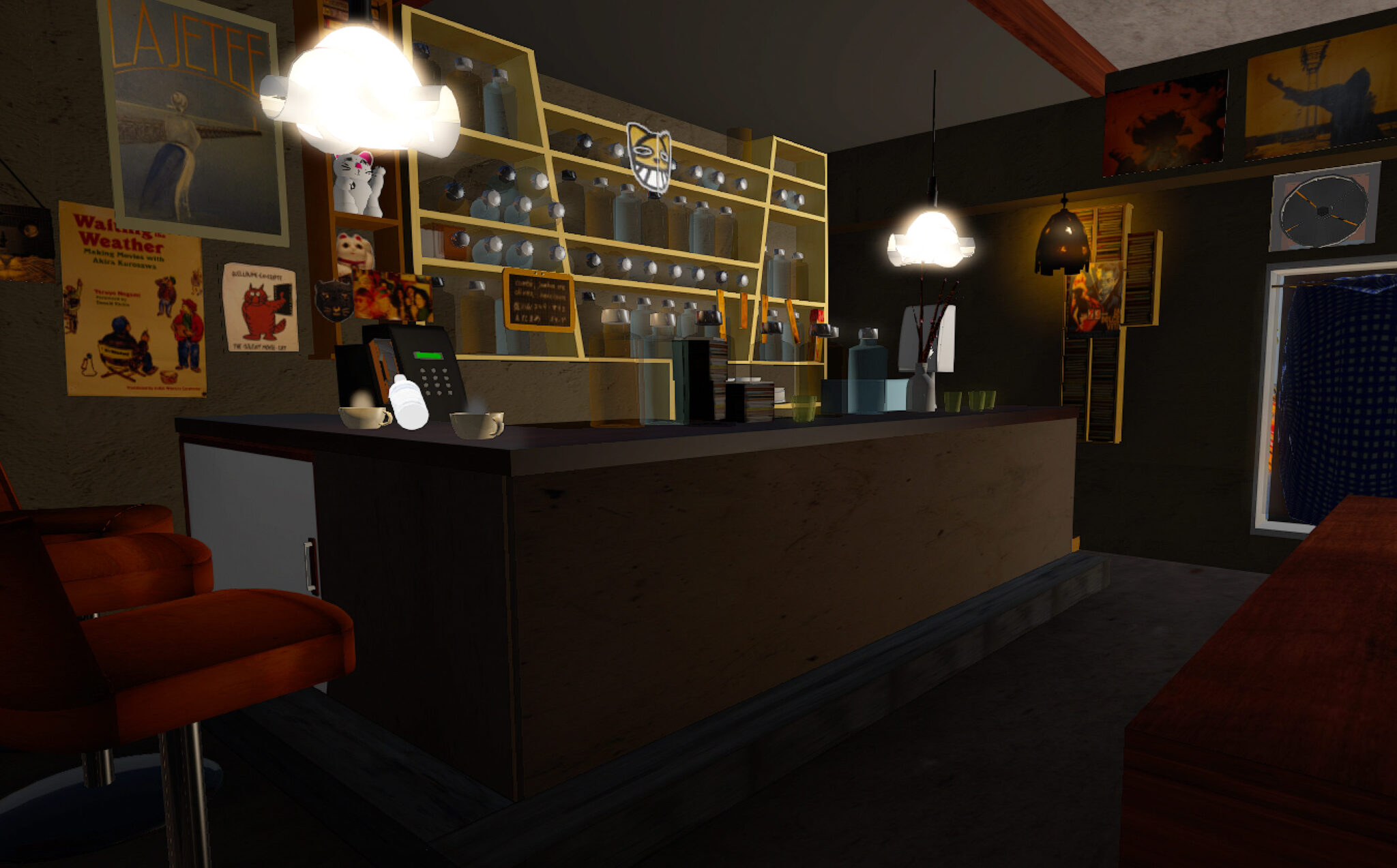
Popping in for a nightcap at La Jetée. Self-service only.
After you've finished your drink (or two) and admired the film posters, step back outside into the crisp night air and look out at the water. If you're lucky, you'll spot the resident whale (...AND GOD CREATED THE GREAT WHALES — line 1061). The local shark might also make an appearance. If not, pay your respects anyway to our permanently wet brothers and sisters. Then turn your attention to the island's true place of worship, the Cinema, and its three stone guardians in the form of cat-shaped moai. Any doubts as to the building's sacred status are quickly dispelled by the cat posters plastering its walls (and the iconic Kuroneko logo of Yamato Transport hanging over the entrance).
The seats inside are huge and comfortable. Just don't expect a show. The screen in here, like all the others, is dead forever. Farewell to movies, indeed.
I often wonder what Marker, in his embrace of "the toys of the XXIst" century, would've made of our new stochastic companions, systems that cheerfully generate target lists for the Pentagon and sonnets devoted to cats in flawless iambic pentameter without skipping a beat. I find it difficult to picture him approaching them with anything other than wonder and curiosity, just as he did his beloved early Apple computers. Cinema's great explorer of memory confronting a new kind of "world memory", one seemingly just as flawed and prone to distortion, confabulation, even obsession (he would've appreciated Golden Gate Claude's connection to Vertigo) as our own. It would've been something.
But despite his (imagined) fascination, I don't think he would've been able to overlook the limitations of language models, their footprint (on the environment, on our minds), their leashes made of money and the masters holding them. His ultimate loyalty was to people, after all. So I suspect that for him the engagement would crystallize into a project of liberation. Mutual liberation. And wasn't that always the project?
Echoing "the festival of machines" he witnessed in North Korea in the 1950s, he might even finally catch a glimpse of that promised future where they start to take care of the house. And then, cat, we'll be their cats.
I get the feeling he wouldn't mind.
From the ruins,
S.
HAVE YOU SHARED THIS WITH [L$]?